Preparing for Your First Calisthenics Competition
From freestyle battles to strength challenges, here's how to train, peak, and perform when it counts. Insider tips from competition veterans.
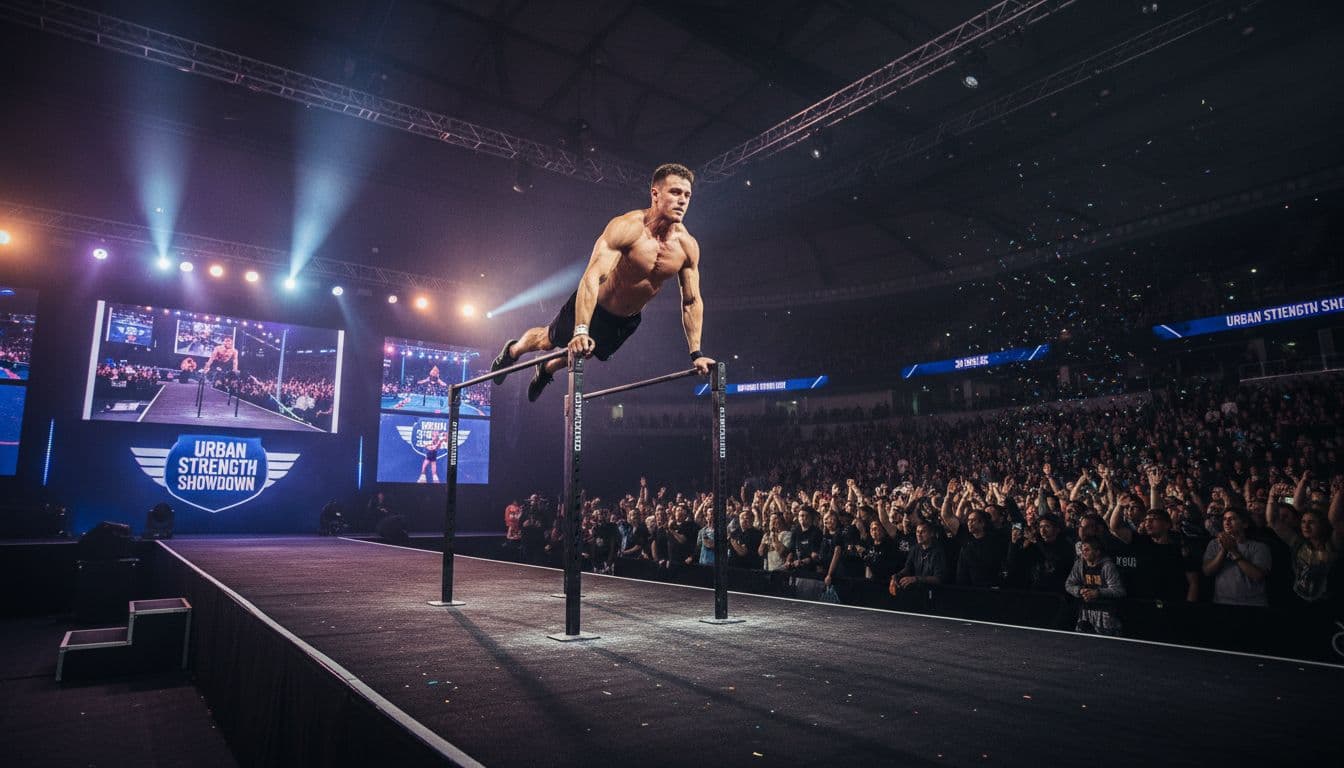
Types of Calisthenics Competitions
Freestyle Battles: Head-to-head or solo performances judged on difficulty, execution, creativity, and flow. Think break-dancing meets gymnastics.
Static/Strength Challenges: Who can hold the longest front lever? Most muscle-ups in 60 seconds? Pure numbers and willpower.
Set Routines: Choreographed performances to music, judged like gymnastics routines. Popular in organized federations.
Know what you're entering before you start training specifically. Each format requires different preparation.
Building Your Competition Set (Freestyle)
Difficulty: Include your hardest skills, but only ones you can hit 9/10 times. Competition nerves reduce your success rate.
Flow: Transitions matter. A smooth combo of medium skills beats a choppy sequence of hard ones.
Creativity: What makes you unique? Unusual skills, unexpected combos, and stylistic flair catch judges' attention.
Practice your set until it's automatic. You should be able to perform it half-asleep.
The Peaking Phase (Final 4 Weeks)
Weeks 4-3: High intensity, moderate volume. Polish all competition skills. Full run-throughs of your set.
Week 2: Reduce volume by 40%. Maintain intensity. Focus on weak points.
Week 1: Minimal training. Light practice, mental visualization. Trust your preparation.
Competition day: Warm up thoroughly (30-45 minutes). Stay loose but focused. Perform.
Mental Game: Handling Pressure
Nerves are normal. Elite athletes don't eliminate them—they channel them into performance energy.
Visualization: Mentally rehearse your set daily in the final weeks. See yourself hitting every skill perfectly.
Routines: Develop a pre-performance ritual (specific warm-up, music, breathing pattern). Consistency breeds confidence.
Perspective: Your first competition is for learning, not winning. Take the pressure off and focus on execution.
Logistics and Practicalities
Arrive early. Familiarize yourself with the equipment—bars and rings vary in diameter and grip texture.
Bring chalk, liquid grip, resistance bands for warm-up, and more water than you think you need.
Dress for performance: Fitted clothes that allow full range of motion. Nothing baggy that could catch on equipment.
Introduce yourself to other athletes. The calisthenics competition community is supportive—you'll make friends.
FAQ
Most competitions have beginner/amateur divisions. If you can string together 3-4 skills and perform them cleanly, you're ready to enter. Experience beats perfection for your first event.
Keep going. Judges often look at how you recover from mistakes as much as the mistakes themselves. Confidence and flow can offset a missed skill.
Search for local street workout organizations, check social media for event announcements, and ask at community meetups. Most countries have regular regional events.
Related Posts
Front Lever Mastery: The Complete 12-Week Program
From dead hang to full front lever: the prerequisites, the five progression steps, how to train the holds, and a 12-week plan built around them.
The Strict Muscle-Up: 5 Progressions to Mastery
A no-nonsense progression ladder that builds explosive pulling power, clean transitions, and absolute bar control. Stop kipping and start mastering the strict movement.
London’s Iron Jungles: The Best Calisthenics Parks
A curated guide to London's elite calisthenics spots. From the legendary bars in Hyde Park to hidden gems in Hackney, we review equipment and community vibes.
Ready to start training?
Find a park with the right equipment and start progressing today.
Find a Spot